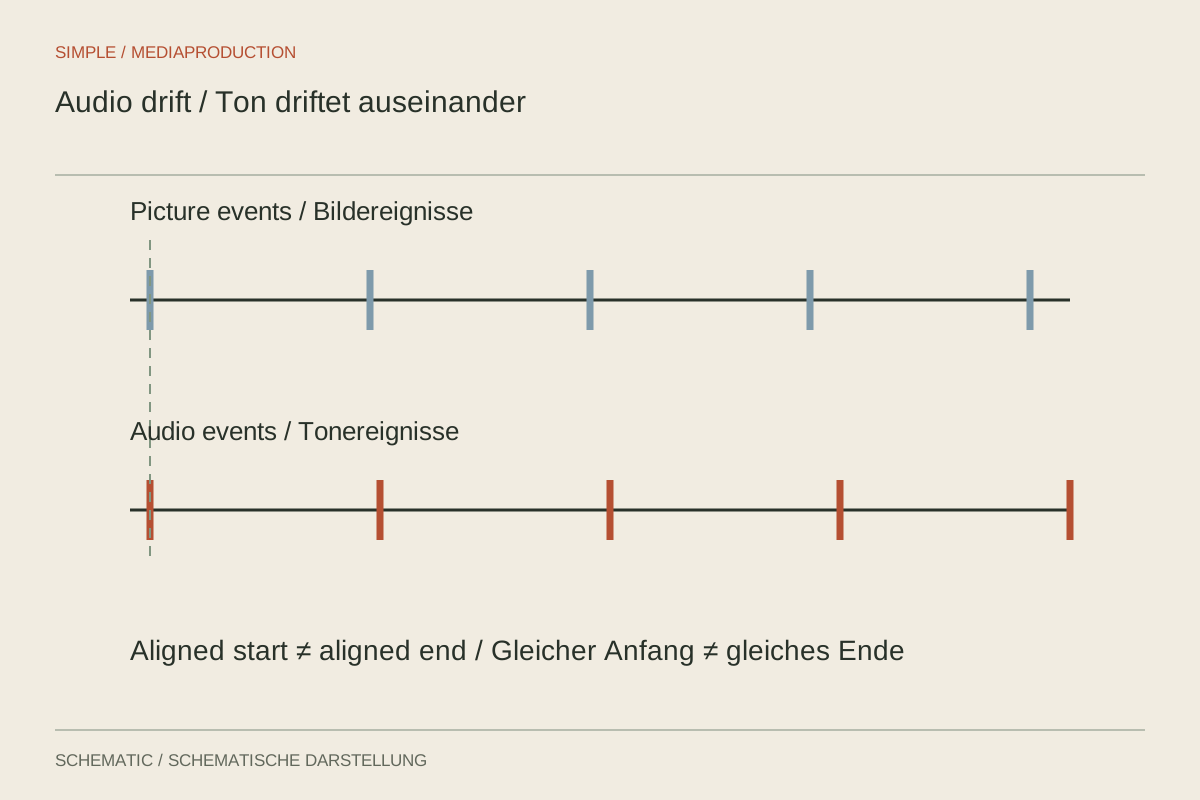
Picture and voice match at the beginning but not twenty minutes later. Simply moving the entire audio track does not solve this: the end may align while the beginning becomes wrong. Before changing speed, distinguish three cases. A constant offset stays unchanged, drift grows over time, and a jump appears suddenly at one point.
Mark several comparison points
Find clear mouth movements or shared transients near the beginning, middle and end. Note the approximate discrepancy at each. Do not rely only on a sustained vowel; visible lip contact during a distinct sound is easier to judge. Check a short export too if the editing preview itself stutters.
If the error is identical everywhere, a single shift may suffice. If it grows approximately evenly, differing running speeds or incorrect interpretation are possible. If it appears suddenly, inspect edits, recording gaps and file restarts. These patterns lead to different investigations and should not all be treated with the same control.
Inspect properties and earlier processing
Check actual file values and previous conversions. Do not merely relabel sample rate to make a file appear compatible. Correct resampling preserves duration; incorrect interpretation can change duration and pitch. Altering video frame-rate interpretation can likewise change timing when footage is played differently rather than properly converted.
Phones and screen recordings may use variable frame rates. Reliable handling depends on the format and the editor's implementation. Consult current documentation and, if needed, test a properly generated constant-frame-rate working copy. Keep the original and compare duration and several sync points before replacing it.
Correct genuine uniform drift carefully
Independent recorders can run on slightly different clocks despite identical nominal settings. If a constant relative discrepancy is established, a very small duration adjustment may help. Deliberately define the start and end of the relevant region and use suitable pitch-preserving processing for speech.
For example, an audio section between two shared events lasts 1,800.3 seconds while the matching picture lasts 1,800.0 seconds. The desired new duration is approximately 99.9833 percent of the old duration. An application requesting speed instead needs the inverse factor, approximately 100.0167 percent. Do not confuse these values, and verify the result independently from the calculation.
This method does not fit an abrupt missing section. If a file drops out mid-take, uniform stretching would alter all previously correct moments. Divide such regions according to the actual events and document gaps. Synchronisation cannot recover missing content.
Verify throughout after correction
Check additional points between the beginning and end. An adjustment matching only the endpoints may remain wrong internally. Listen for time-processing artefacts, particularly on consonants. If playback is delayed only through one particular device, the problem may lie outside the file.
Keep an unchanged synchronisation version and note the factor, method and affected region. This makes the decision reversible and traceable to associated tracks. For future long recordings, shared time references and a full rehearsal are more useful than assuming matching menu values automatically guarantee identical running time.
Exclude a constant playback delay
When uncertain, compare local playback with wired audio and another known player. If the same exported file appears offset only through particular wireless headphones, do not immediately alter the timeline. Compensating for that one monitoring path could make the file incorrect for other viewers. Always document where the discrepancy was observed.
Understand the region between measurement points
Imagine three checked points: at minute one, sound matches; at minute ten, it differs by two frames; at minute twenty, suddenly by twenty frames. This is not convincing evidence of uniform drift. Search around the sharp increase for an interruption or different processing. One global speed change might hit the final point while missing the middle one.
Conversely, a small discrepancy growing almost linearly can fit different device clocks. Even then, initially correct a copy of the continuous take before dividing it into many short pieces. Otherwise numerous fragments need identical treatment and transitions become harder to trace. Preserve the timing relationships among microphone tracks recorded by the same device together.
Explicitly document every gap. A missing second may be handled with an edit, another relevant view or a repeat. An automatically stretched neighbouring syllable is not a meaningful replacement for lost words.