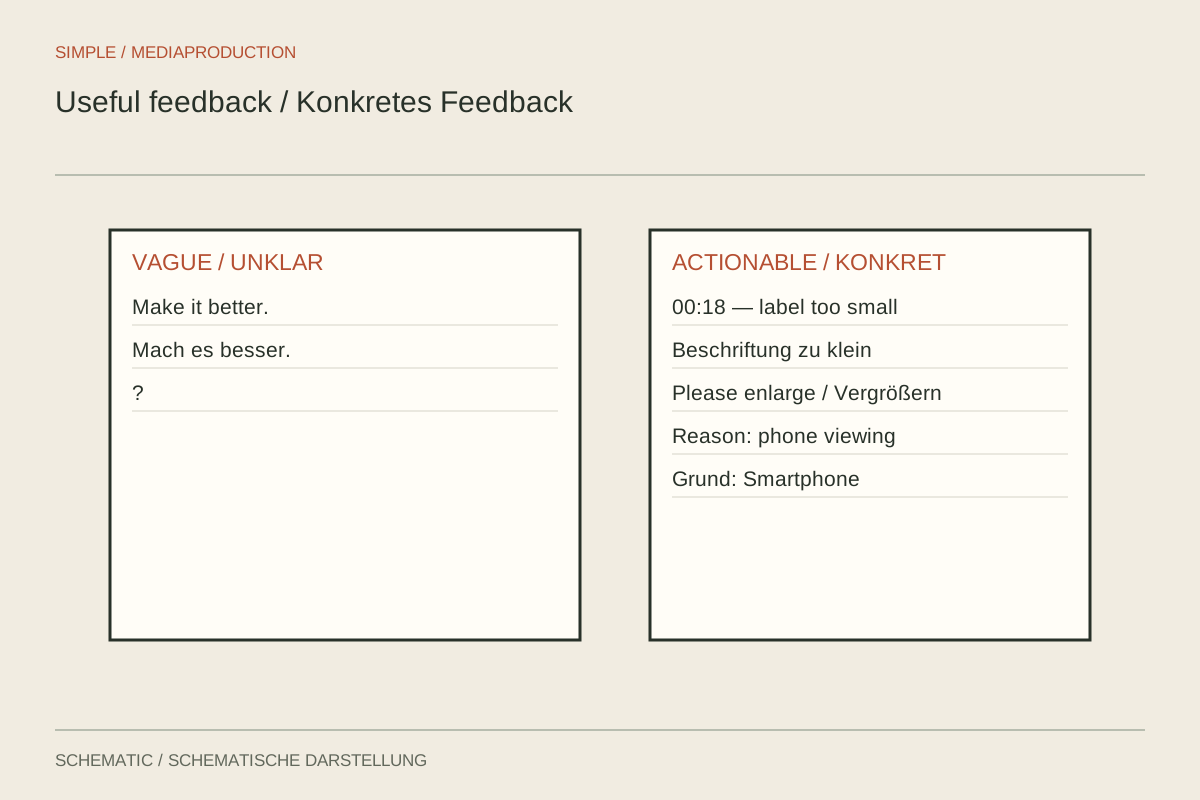
“I do not like it yet” may be honest, but gives little direction for the next revision. A useful feedback request asks specific questions about the draft and explains what can already be judged. In a rough cut, selection, order and comprehension matter most. Temporary colour or missing music may deliberately remain unresolved. Making that distinction avoids polishing details that may later disappear.
Set a task rather than asking for taste
Ask viewers to explain what they understood or which action they could take next. For a tutorial, ask “Which two parts are connected first?” An incorrect answer reveals a specific gap. It does not yet prove the narration is wrong; the corresponding close-up may be absent, or the sequence may be ambiguous.
Also ask where uncertainty arose. A timecode and short description are more useful than a broad judgement about pace. “At 00:38 I cannot tell which socket is meant” is actionable. “Make it more dynamic” needs translation: is the action too slow, is visual variety missing, or does the explanation take too long to reach its point?
Limit the review assignment
Send a version with an unmistakable identifier and name two or three current review goals. A subject specialist can answer different questions from someone with no prior knowledge. The first may check the factual sequence; the second may assess whether it can be followed. Both perspectives matter, but they should not be treated as interchangeable evidence.
Ask reviewers to separate problems from proposed remedies. “The product cannot be recognised” is a problem; “zoom in” is one possible remedy. Another take or a brief label might work better. Following only the suggested action can leave the underlying comprehension issue unresolved, especially when the reviewer has not seen the alternative footage available.
Consolidate contradictions
Collect comments in one list and rank them by relevance to the intended result. Conflicting opinions may reveal different audiences. Resolve the choice against the brief rather than the loudest voice. Mark completed changes and explain briefly when a suggestion is not adopted. This prevents the same unresolved discussion recurring in every round.
Check the whole sequence after substantial revisions. Shortening one sentence can remove a reference needed later, even when the individual moment improves. Ask for more than inspection of the changed seconds: include a complete viewing of the new version. Feedback then remains a tool for the film as a whole rather than a collection of disconnected local preferences.