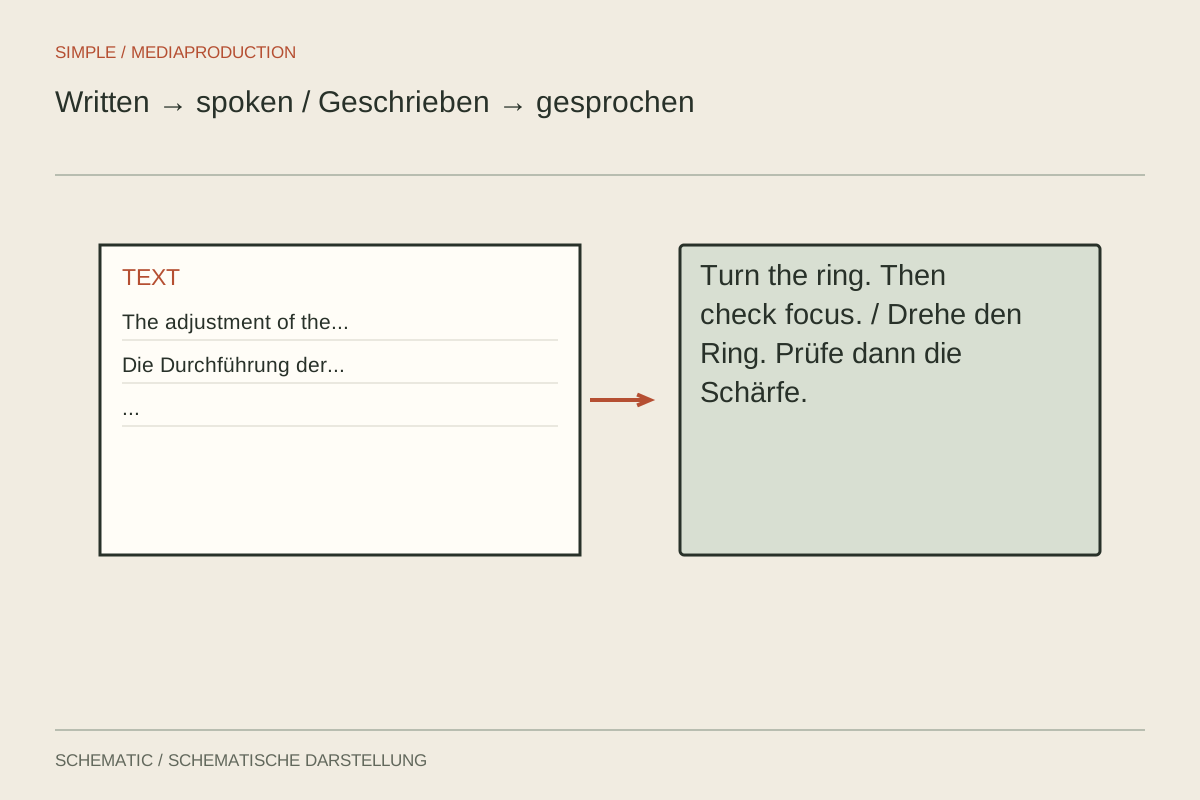
A sentence can look elegant on paper and become awkward when spoken. Listeners cannot skip backwards as easily as readers. A video script should make relationships immediately clear: who does something, with what, and why? Write the first version freely if that helps. The real editing starts when you read it aloud and compare it with the planned pictures.
Begin with an action
“Following the release of the mechanism situated on the side, the cover may be removed” is easier to say as “Open the latch on the side. Then lift off the cover.” Each action gets room in the picture. Simpler wording is not necessarily childish; it makes the sequence audible. Technical terms remain useful when they identify the exact part the audience needs to recognise.
Avoid introducing several unfamiliar names in one breath. In a camera explanation, introduce shutter speed and show its value before moving to other settings. A pronoun such as “this” can become ambiguous when several objects are visible. Repeat the object's name when necessary. Spoken repetition often feels more natural than it looks on the page, especially when the picture has just changed.
Edit the script with your mouth
Read at a normal pace and mark places where you unexpectedly need a breath or a restart. Look for nested clauses, long strings of numbers or unfamiliar word combinations. Split a sentence only if its connection survives. Three abrupt statements can be harder to understand than one calm sentence with a clear relationship between its parts.
Write numbers so the speaker knows how to pronounce them. A model number may be read differently from a quantity. Record agreed pronunciations for names, but do not accidentally include these working notes in captions. Expand abbreviations when the audience will not know them. One explanation is usually enough for later references, provided there is no long gap or change of subject.
Leave room for the pictures
Narration need not duplicate every visible movement. It can explain the decision while the image demonstrates the action: “Turn only until the resistance eases.” Then allow time for the real movement. When the action takes longer than the sentence, the pause is part of the explanation, not an empty space that must be filled with more words.
Record a rough voice track and place it against simple footage or still frames. Check whether important words occur before, during or after their corresponding detail. If the result runs long, remove repetition and secondary information first. Speaking faster rarely fixes an overloaded explanation. Afterwards, someone without the script should be able to describe what they are supposed to do or understand.