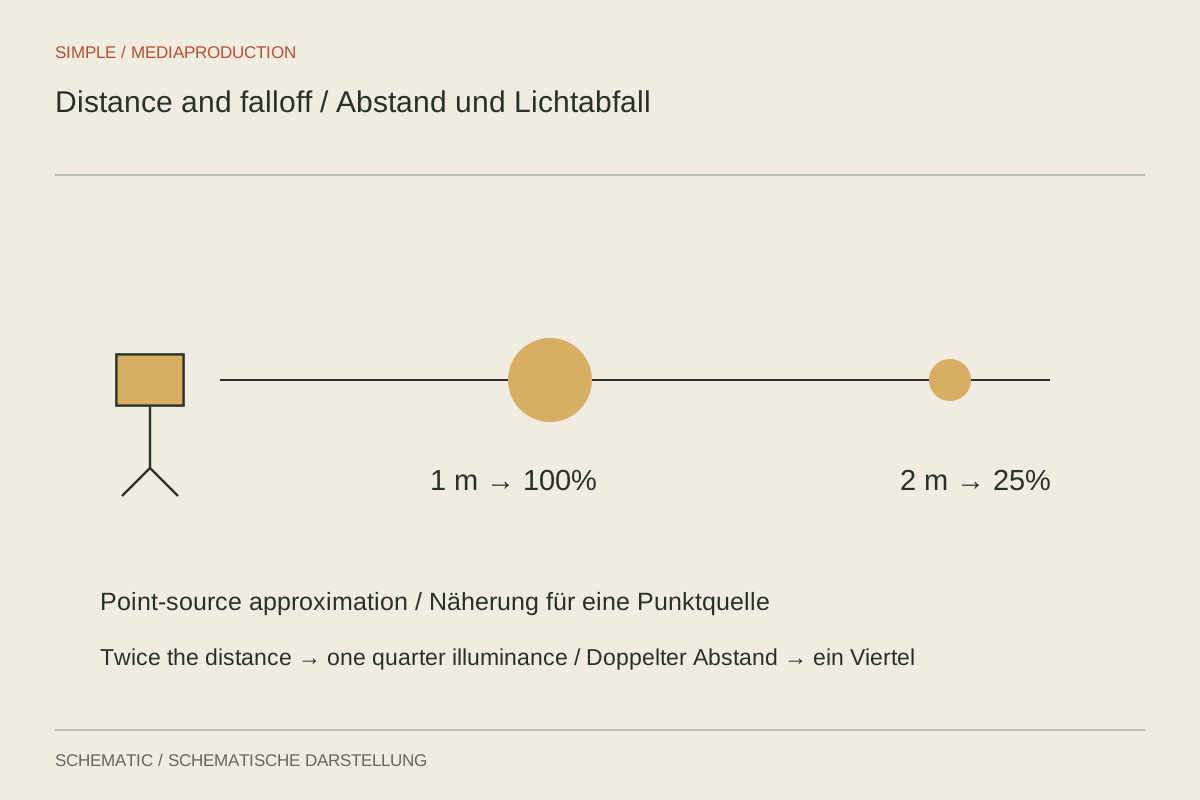
A fixture close to a speaker can produce a bright face and a dark background. Move the same fixture farther away and compensate its output, and the background may appear relatively brighter. This follows from the different distances to the source. What matters for the image is not just the distance to the face, but the relationship between distances to all visible surfaces.
Understand the simple approximation
For an ideal point source, light spreads over a larger area as distance increases. Doubling distance gives one quarter of the illuminance under those idealised conditions. Real softboxes, reflectors and large nearby surfaces do not behave exactly like this in every position. Use the relationship as guidance and inspect the actual camera image.
A hypothetical example shows the direction of change. If the face is one metre from a small source and the wall two metres away, the wall receives substantially less illumination under simplified conditions. If the source is four metres from the face and five from the wall, the relative distances are closer. After compensating output, the difference between face and wall becomes smaller. Wall colour and the angle of incidence further affect the visible result.
Plan room for movement
With a nearby fixture, leaning forward a few centimetres can change the relative distance considerably. A gesturing speaker may therefore become brighter or darker. A more distant source can provide a more even working area for an energetic demonstration, provided it has sufficient output.
Test the nearest and farthest intended positions. A recording only at the centre says little about the entire working area. An object held towards the camera may be much closer to the light than the face. Check pale packaging carefully so its lettering does not disappear into an overexposed patch.
Change source size and distance together
A softbox appears smaller from farther away. Its shadows may consequently become harder even after exposure is matched. Looking only at the brightness control misses this change. Compare nose shadows, product shadow edges and reflections on glossy surfaces.
Maintaining soft light at a greater distance may require a larger emitting surface. This needs more space and potentially more output. Decide which property matters most: strong falloff for a dark background or even illumination across a larger movement area. One small fixture cannot always deliver both objectives at once.
Do not confuse measurement with auto exposure
Automatic camera exposure can make a distance test misleading. The face appears equally bright because the camera compensates, while background brightness and noise change. Lock the relevant controls for comparison or document each automatic adjustment. Deliberately restore the desired facial exposure after comparing positions. This separates changes caused by lighting geometry from changes caused by the camera. A short trial using a matte surface and a person connects theoretical distance relationships with the actual modifier without pretending it is an exact point source. Repeat the final setting with the planned gestures to check that the usable area is sufficient.