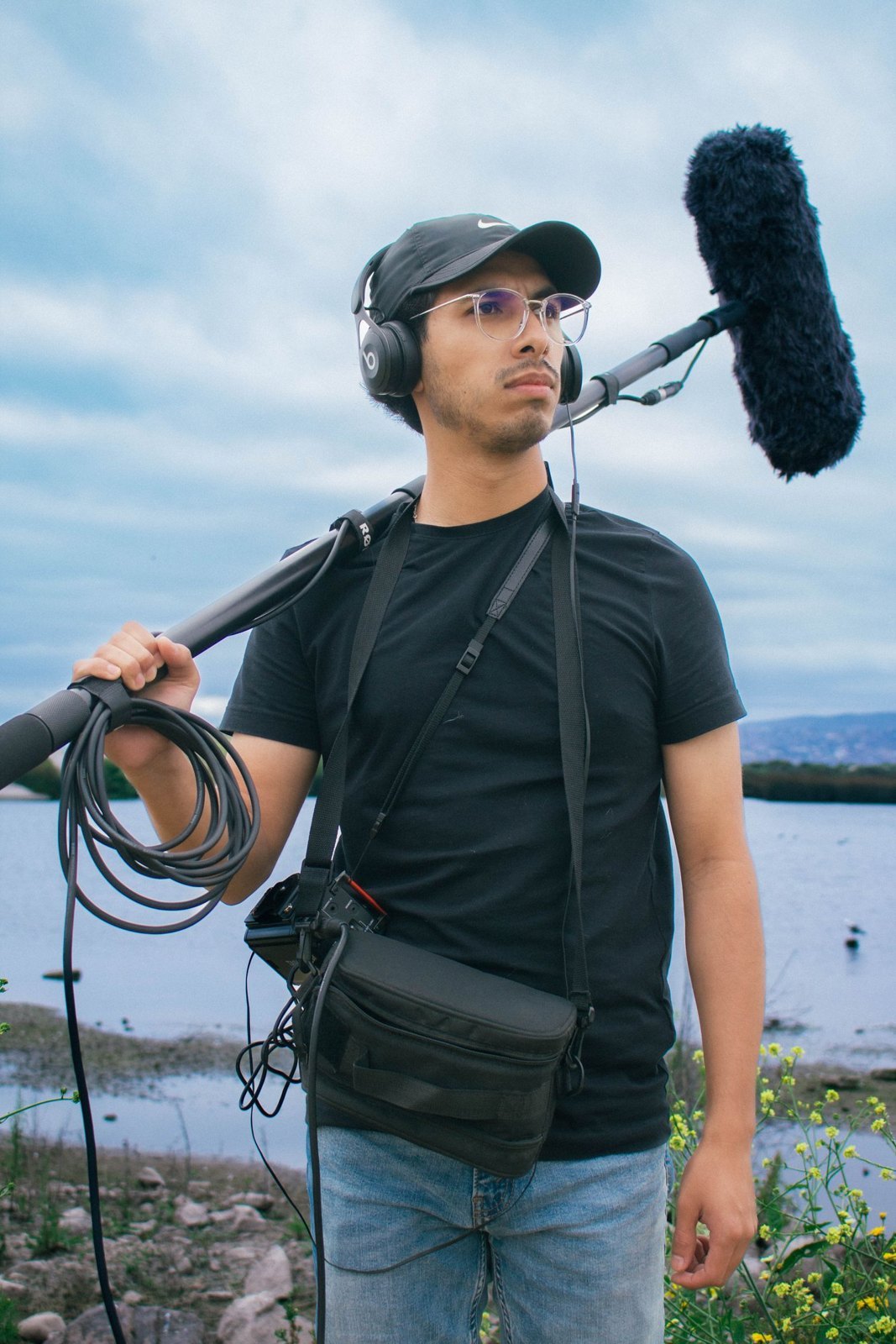
A long shotgun microphone on a camera looks like a substantial audio solution, but remains several metres from the voice when the interview is filmed from several metres away. For intelligible speech, placing the microphone close to the speaker often matters more than its length. A boom pole or suitable stand arm can reduce that distance without appearing in the image.
Establish the frame boundary together
Set the final camera composition first. Carefully lower the microphone into view from above, then withdraw it with a small margin. Check the actual recording frame rather than a potentially cropped monitor display. With two cameras, both frame boundaries matter.
Aim towards the speaking area and listen to the effect of small angle changes. A microphone pointing just past the head towards a wall may capture more room than voice. Exact orientation depends on the model and pickup pattern. Do not assume every elongated microphone receives sound identically from its front.
Account for movement and shadows
Ask the speaker to look towards the interviewer and back. The microphone position needs to cover this normal movement range. Larger movements require an operator following the action or a different arrangement. A narrow angle can sound clear while the person is still and noticeably dull whenever they turn.
Check whether the pole or microphone casts a shadow on the face or background. A window reflection can reveal it too. Placement below the frame is sometimes possible, but needs testing for table reflections, gestures and noise. It is not automatically an equivalent alternative.
Keep the mounting mechanically quiet
Use an appropriate shock mount and route the cable without tension or loose knocking loops. A stand arm must have sufficient load capacity and stability in its extended position. Never leave an unsecured assembly above a person. A handheld boom should be manageable throughout the conversation without noisy grip changes.
Record a sentence followed by a short pause. The pause reveals which fans or room noises are captured from that direction. If necessary, compare a slightly closer placement with tighter framing. If intelligibility improves substantially, changing the composition may accomplish more than buying an even more directional microphone.
A wider shot changes the sound plan
If a close-up becomes a wide shot at the last minute, the boom usually has to move farther away. The previously accepted sound is no longer automatically valid. Record another test and decide whether another microphone is needed. For a scene containing only a few planned words, a separate clean repeat may suit the presentation. A spontaneous interview must not silently become a reconstructed statement, however. Plan sound for each setup when shot sizes change, instead of treating one microphone at increasing distance as an unchanged solution. The wider image may require a different recording approach rather than simply more gain.